



• Soluciones
    • Altos Costos de Combustible
    • Costos de Mantenimiento Inesperados
    • Operaciones optimizadas
    • Entregas exitosas sensibles a la temperatura
    • ELD & DVIR
    • Altos Costos de Seguro
    • Variedad de reportes automatizados
    • Problemas de Desempeño del Conductor
    • Reducción de accidentes con video sobre demanda y en tiempo real
    • Presión de neumáticos
    • Robo de Vehículos y Seguridad
  • Forge AI
  • Industrias
    • Construcción
    • Transporte y Carga
    • Gestión de residuos
    • HVAC, plomería y mantenimiento doméstico
    • Alimentos y Agricultura
    • Minería
    • Logística de Última Milla
    • Flota de Arrendamiento vehicular
  • Productos
    • Dashcams
    • Trackers
    • Sensores
    • Accesorios
    • Seguimiento de activos BLE
  • Precios
  • Recursos
    • Calculadora ROI
    • Blog
    • Aviso de Privacidad
    • Términos y Condiciones
  • Compañía
    • Sobre nosotros
    • Contáctenos
    • Vacantes
    • Ofertas de Trabajo
    • PR Releases
PosiTrace home
  • Soluciones

    Reduzca Costos Operativos

    Altos Costos de Combustible
    Costos de Mantenimiento Inesperados

    Mejore la Seguridad y el Cumplimiento

    Problemas de Seguridad y Cumplimiento
    Altos Costos de Seguro

    Proteja Sus Activos

    Problemas de Desempeño del Conductor
    Robo de Vehículos y Seguridad
    • Altos Costos de Combustible
    • Costos de Mantenimiento Inesperados
    • Operaciones optimizadas
    • Entregas exitosas sensibles a la temperatura
    • ELD & DVIR
    • Altos Costos de Seguro
    • Variedad de reportes automatizados
    • Problemas de Desempeño del Conductor
    • Reducción de accidentes con video sobre demanda y en tiempo real
    • Presión de neumáticos
    • Robo de Vehículos y Seguridad
  • Forge AI
  • Industrias

    Industrias

    Construcción
    Transporte y carga
    Gestión de residuos
    HVAC, plomería y mantenimiento doméstico
    Alimentos y agricultura
    Minería
    Logística
    Arrendamiento y financiamiento vehicular
    • Construcción
    • Transporte y Carga
    • Gestión de residuos
    • HVAC, plomería y mantenimiento doméstico
    • Alimentos y Agricultura
    • Minería
    • Logística de Última Milla
    • Flota de Arrendamiento vehicular
  • Productos
    Products
    Dashcams
    Trackers
    Sensors
    Accessories
    BLE Asset Tracking
    • Dashcams
    • Trackers
    • Sensores
    • Accesorios
    • Seguimiento de activos BLE
  • Precios
  • Recursos
    Resources
    ROI Calculator
    Blog
    Privacy Policy
    Terms of Service
    Webinars
    • Calculadora ROI
    • Blog
    • Aviso de Privacidad
    • Términos y Condiciones
  • Compañía
    Recursos
    Sobre Nosotros
    Contáctenos
    Socios
    Carrera
    Vacantes
    Comunicados de Prensa
    • Sobre nosotros
    • Contáctenos
    • Vacantes
    • Ofertas de Trabajo
    • PR Releases
Ingresar
  • ESP
    • ENG
Logo_Positrace_horizontal.svg
Isotype_Positrace.svg
  • Soluciones

    Reduzca Costos Operativos

    Altos Costos de Combustible
    Costos de Mantenimiento Inesperados

    Mejore la Seguridad y el Cumplimiento

    Problemas de Seguridad y Cumplimiento
    Altos Costos de Seguro

    Proteja Sus Activos

    Problemas de Desempeño del Conductor
    Robo de Vehículos y Seguridad
    • Altos Costos de Combustible
    • Costos de Mantenimiento Inesperados
    • Operaciones optimizadas
    • Entregas exitosas sensibles a la temperatura
    • ELD & DVIR
    • Altos Costos de Seguro
    • Variedad de reportes automatizados
    • Problemas de Desempeño del Conductor
    • Reducción de accidentes con video sobre demanda y en tiempo real
    • Presión de neumáticos
    • Robo de Vehículos y Seguridad
  • Forge AI
  • Industrias

    Industrias

    Construcción
    Transporte y carga
    Gestión de residuos
    HVAC, plomería y mantenimiento doméstico
    Alimentos y agricultura
    Minería
    Logística
    Arrendamiento y financiamiento vehicular
    • Construcción
    • Transporte y Carga
    • Gestión de residuos
    • HVAC, plomería y mantenimiento doméstico
    • Alimentos y Agricultura
    • Minería
    • Logística de Última Milla
    • Flota de Arrendamiento vehicular
  • Productos
    Products
    Dashcams
    Trackers
    Sensors
    Accessories
    BLE Asset Tracking
    • Dashcams
    • Trackers
    • Sensores
    • Accesorios
    • Seguimiento de activos BLE
  • Precios
  • Recursos
    Resources
    ROI Calculator
    Blog
    Privacy Policy
    Terms of Service
    Webinars
    • Calculadora ROI
    • Blog
    • Aviso de Privacidad
    • Términos y Condiciones
  • Compañía
    Recursos
    Sobre Nosotros
    Contáctenos
    Socios
    Carrera
    Vacantes
    Comunicados de Prensa
    • Sobre nosotros
    • Contáctenos
    • Vacantes
    • Ofertas de Trabajo
    • PR Releases
Ingresar
  • ESP
    • ENG
Sin categorizar

The $2,000/Hour Mistake 87% of Construction Companies Make Daily

Bill Kornilo, CEO
October 10, 2025

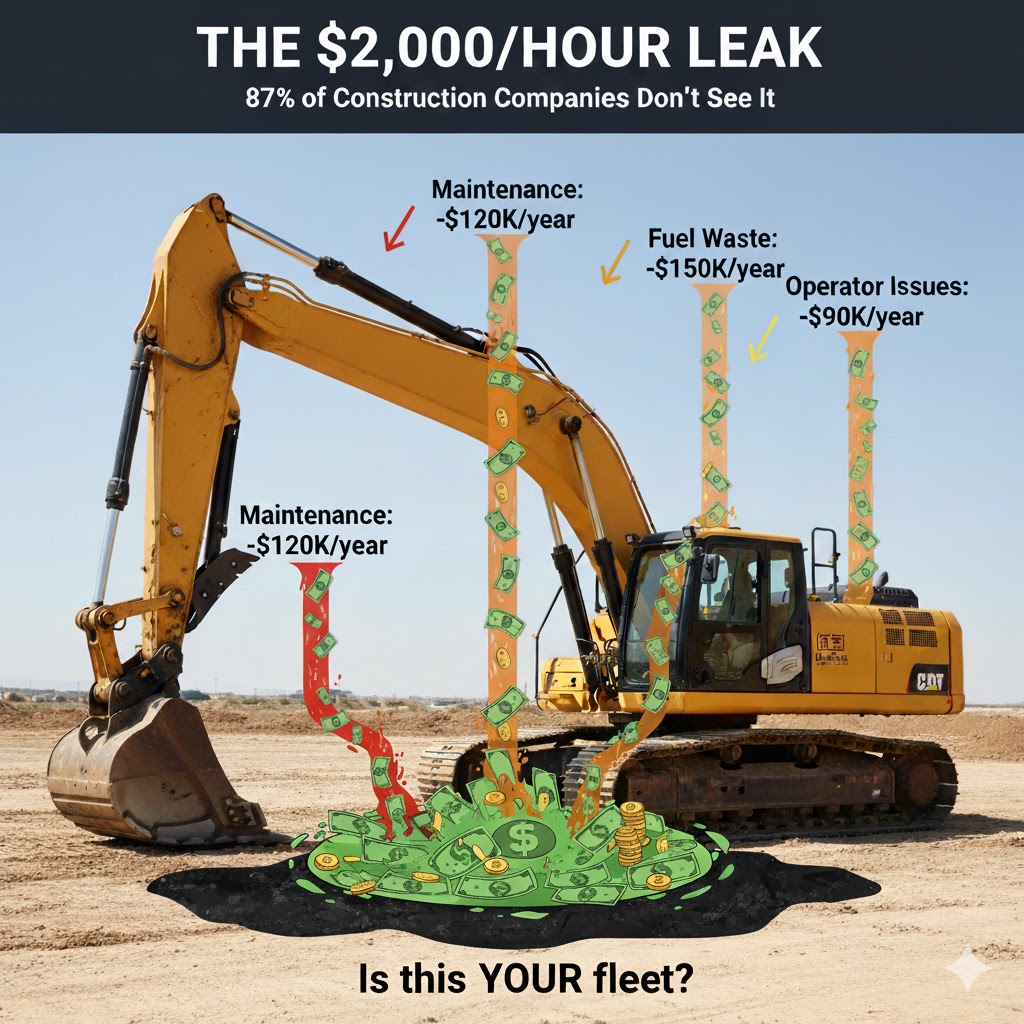
After analyzing 200+ construction fleets across BC and Alberta, we’ve identified a consistent pattern: companies with 20-300 pieces of equipment are losing an average of $2,000-$10,000 per hour to preventable inefficiencies.

The interesting part? Most of these companies are profitable and well-run. They just lack visibility into three specific operational areas.

The Data That Started This Research

During a routine fleet audit last year, we helped a Vancouver-based contractor identify $847,000 in annual operational waste. This wasn’t unusual – it was typical.

Since then, we’ve documented similar findings across 87% of construction fleets we’ve analyzed.

Here’s what the data shows:

Average Annual Losses (50-Unit Fleet):

  • Reactive maintenance: $120,000-$180,000
  • Fuel inefficiency: $75,000-$150,000
  • Non-productive equipment hours: $100,000-$200,000
  • Operator inefficiency: $45,000-$90,000

These aren’t made-up numbers. They’re aggregated from actual telematics data across hundreds of fleets.

Three Critical Gaps in Construction Operations

1. Maintenance: Still Calendar-Based in a Digital World

Most construction companies schedule maintenance based on calendar dates or rough hour estimates. The problem: Equipment usage varies dramatically between units and projects.

What we see in the data:

  • 15-30% premium on emergency repairs vs. planned maintenance
  • 60% of “unexpected” breakdowns show warning signs 48-72 hours prior
  • Average of 3.2 days additional downtime per breakdown vs. scheduled service

The solution that’s working: Telematics-based maintenance using actual engine hours and diagnostic codes. Companies implementing this see maintenance costs drop 25-40% within the first year, primarily through:

  • Predictive alerts before failures occur
  • Optimized service intervals based on actual use
  • Digital service records that follow the equipment

A Kelowna excavation company reduced emergency repairs by 60% in year one, saving $85,000. Not revolutionary – just better data application.

2. Fuel Management: The Hidden 15-25% of Operating Costs

Fuel is a massive expense, yet most companies have limited visibility into actual consumption patterns.

Common inefficiencies we track:

  • Equipment idling: 2-4 hours daily at $25-50/hour
  • Fuel run time: 15-22 hours weekly per fleet
  • Theft/unauthorized use: 3-5% of total fuel spend
  • Manual reconciliation errors: 5-10 hours monthly admin time

What’s actually working:

Automated fuel tracking combined with mobile fueling services. Through our integration with Fuelsrv (they service Vancouver to Fort Nelson), fleets can:

  • Eliminate fuel runs entirely (equipment is fueled on-site)
  • Access bulk pricing (typically $0.15-0.35/L savings)
  • Automate reconciliation (100% accuracy, zero admin time)
  • Track consumption by project for accurate job costing

The math is straightforward: A 50-unit fleet spending $500K annually on fuel typically saves $75K-150K through better tracking and mobile delivery.

3. Operator Performance: The 30% Variable Nobody Measures

The performance gap between your best and worst operators is approximately $30,000 per year in fuel consumption, equipment wear, and incident risk.

Measured performance differences:

  • Top 20% of operators use 30-40% less fuel
  • Bottom 20% cause 3X more equipment damage
  • Harsh operation events correlate directly with maintenance costs

The approach that works:

Instead of punitive measures, successful fleets use gamification:

  • Daily scorecards showing improvement opportunities
  • Peer comparisons (anonymous but ranked)
  • Focus on trends rather than absolute scores

Results are consistent: 25-35% improvement in operator behavior within 90 days, translating to $15K-30K savings per problem operator annually.

Real Implementation Timeline

Based on actual client implementations, here’s what a typical 90-day rollout looks like:

Month 1: Baseline and Deploy

  • Install telematics (0.5-1 hours per unit, no operational downtime)
  • Establish baseline metrics
  • Set up automated maintenance scheduling
  • Launch basic operator scorecards

Month 2: Optimize

  • Analyze first month’s data for quick wins
  • Implement fuel management improvements
  • Begin operator coaching for bottom performers
  • Test mobile fueling for remote equipment

Month 3: Scale

  • Roll out digital inspections
  • Expand successful programs fleet-wide
  • Integrate with existing systems (accounting, dispatch)
  • Calculate actual ROI for continued investment decisions

By day 90, most fleets have recovered their investment and identified 6-12 months of additional optimization opportunities.

The Economics (With Real Numbers)

For a typical 50-unit construction fleet:

Annual Investment:

  • Telematics hardware/software: $30,000-40,000
  • Mobile fueling program: $15,000-20,000 (service fees)
  • Training and implementation: $5,000-10,000
  • Total: $50,000-70,000

Documented Annual Savings:

  • Maintenance optimization: $85,000-120,000
  • Fuel efficiency: $45,000-75,000
  • Productivity recovery: $90,000-150,000
  • Insurance reductions: $15,000-25,000
  • Total: $235,000-370,000

ROI Range: 3.5X to 7.4X in Year One

These aren’t projections – they’re averages from actual implementations.

Why Mid-Market Construction Is the Sweet Spot

Companies with 20-300 units see the best results because:

  1. Scale for impact: Savings are material to the bottom line
  2. Agility to implement: No enterprise bureaucracy
  3. Ownership involvement: Direct decision-making speeds adoption
  4. Competition pressure: Need efficiency to compete with larger players

Enterprise fleets take 18-24 months to see similar results. Mid-market achieves it in 90-120 days.

Common Objections (And Honest Answers)

“We’ve tried GPS tracking before.” Modern telematics isn’t just dots on a map. It’s predictive maintenance, fuel analytics, and operational intelligence. The technology has evolved significantly in the last 5 years.

“Our operators won’t like being tracked.” In our experience, good operators appreciate the data because it proves their value. The resistance typically comes from the bottom 20% – which is valuable information itself.

“We don’t have time for another system.” Implementation takes 2-3 hours per unit. Daily management takes 15 minutes. If you don’t have 15 minutes to save $1,000/day, the problem isn’t time.

Next Steps (If This Makes Sense)

If you’re running 20+ pieces of equipment and experiencing:

  • Unexpected breakdowns during critical project phases
  • No visibility into true equipment costs per project
  • Manual fuel tracking taking hours weekly
  • Equipment sitting idle at remote sites waiting for fuel

It might be worth a conversation about whether this approach fits your operation.

We routinely identify $250K+ in annual savings within the first assessment.

No aggressive sales pitch. Just a discussion about whether the math works for your specific situation.


About the Partnership

Positrace specializes in construction fleet telematics with a focus on practical ROI. We partner with Fuelsrv for mobile fueling services across BC, creating an integrated solution that addresses both data and logistics challenges.

Not every fleet needs this. But for those that do, the impact is measurable and significant.


construciton ROIdowntime controlfuel optimizationoptimización

Related Articles


Business protection  ·  Sin categorizar
¿Cómo el rastreo por GPS puede ayudar a prevenir el robo de remolques?
Optimización de beneficios  ·  Sin categorizar
¿Cómo aumentar la eficiencia del combustible?
Optimización de beneficios
What is ABS? The Complete Guide to Anti-lock Braking Systems for Fleet Safety

Leave A Reply Cancel reply

Your email address will not be published. Required fields are marked *

*

*

¿Cómo las aplicaciones de seguimiento de flotas GPS mejoran el ROI?
Previous Article
Cámaras con IA para Flotillas Empresariales: Resultados Comprobados para Operaciones de 300+ Vehículos en México
Next Article